🌾 Grain Equilibrium Moisture Content Calculator
Calculate EMC for safe grain storage using temperature & relative humidity — supports 8 grain types
| Relative Humidity (%) | Approx. EMC (%) | Storage Risk | Recommended Action |
|---|---|---|---|
| 40–50% | 9.5–11.0% | 🟢 Very Safe | Long-term storage OK |
| 50–60% | 11.0–12.5% | 🟢 Safe | Standard storage conditions |
| 60–65% | 12.5–13.0% | 🟡 Marginal | Monitor closely, short-term OK |
| 65–70% | 13.0–13.9% | 🟡 Caution | Dry down recommended |
| 70–75% | 14.0–15.5% | 🔴 Danger | Dry immediately |
| >75% | >15.5% | 🔴 High Risk | Spoilage likely, aerate urgently |
| Grain | Constant C | Constant K | Constant N |
|---|---|---|---|
| Corn | 35.703 | 0.000086541 | 1.8634 |
| Wheat | 27.621 | 0.000053051 | 2.0800 |
| Soybean | 14.401 | 0.000106460 | 2.2726 |
| Rice (Rough) | 51.161 | 0.000019187 | 2.4451 |
| Barley | 20.000 | 0.000058900 | 2.1463 |
| Sorghum | 25.728 | 0.000076514 | 2.0139 |
| Oats | 18.996 | 0.000081839 | 1.9810 |
| Canola | 11.380 | 0.000124560 | 2.3000 |
| Temp °F | Temp °C | Wheat EMC (%) | Storage Status |
|---|---|---|---|
| 32°F | 0°C | ~14.8% | 🔴 Too High — Dry |
| 40°F | 4°C | ~14.2% | 🟡 Caution |
| 50°F | 10°C | ~13.5% | 🟡 Marginal |
| 60°F | 15°C | ~13.0% | 🟢 Safe Limit |
| 70°F | 21°C | ~12.4% | 🟢 Safe |
| 80°F | 27°C | ~11.8% | 🟢 Safe |
| Starting MC (%) | Target MC (%) | Water Removed (lb/bu) | Water Removed (kg/t) |
|---|---|---|---|
| 18% | 13% | 3.28 | 64.7 |
| 20% | 13% | 4.55 | 89.8 |
| 22% | 13% | 5.82 | 114.8 |
| 25% | 13% | 8.00 | 157.9 |
| 15% | 11% | 2.55 | 50.3 |
| 16% | 10% | 3.93 | 77.6 |
The content of moisture in grains measures the amount of water inside them. It ranks among the main signs of grain quality. Naturally grains have moisture that adjusts according to surroundings, conditions during harvest and ways of storage.
You call grain straight grade if it is inside allowed limits of moisture If the moisture grows, you call it tough, damp, wet or moist.
Why Moisture in Grains Matters
Amount of moisture is not a problem for grain harvest. The actual cause is what happens because of too much or too little water. Between grains and its moisture exists a strong link.
During handling of grains it helps to well control things. Too much water hurts and too litle also.
Moisture in grains seriously affects its quality, storage and sale. That everything helps farmers reach better profit. For instance, for harvesting of corn without mechanical wounds 22% of moisture is best.
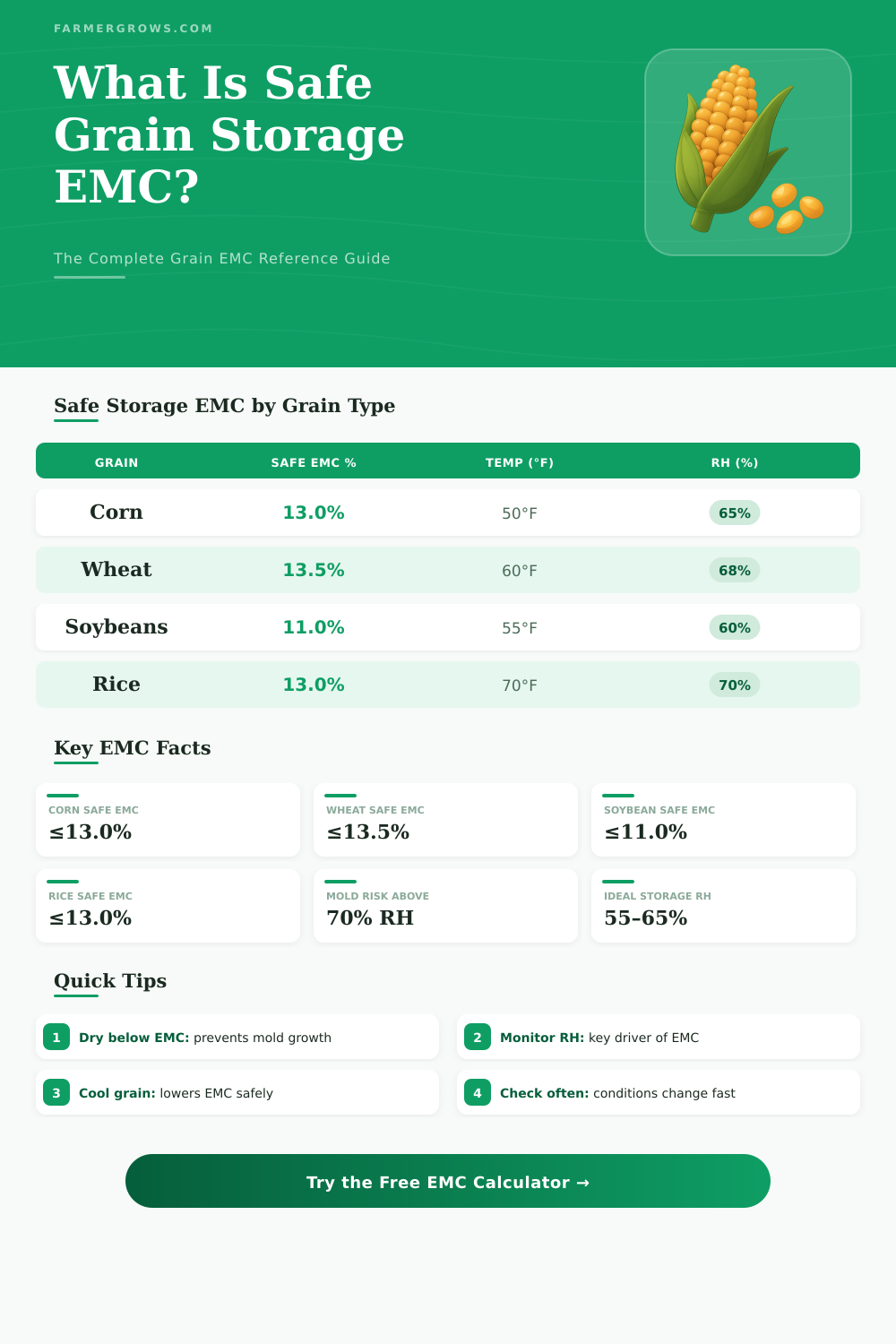
For stored corn it must be 14% or lower. The longer corn stays in the field, the more it dries naturally. Ideal moisture for corn during storage is 13% or less.
Wheat can reach balanced moisture of 13.6% if the air stays at 10°C and 60% relative humidity. Whether you start with higher or lower level than 13.6%, it will reach it. Beans are hygroscopic and absorb or lose moisture very quickly during the day.
Rye you cut when the moisture of the kernel reaches 40 to 45 percent, and later happens the real harvest after slow drying in the field.
Heat build up in grains above 55°C because of insects, mold or too much humidity commonly causes a musty smell in rice. Rice kept long under bad conditions, as high moisture or high temperatures, develop smells that strongly lower its market value.
Grain moisture meter helps to estimate the percentage of water in grains. Its main task is to check whether grains are ready for the next stage in production. No matter what setting you use, the meter requires calibration according to the grain type.
Testing of several samples gives a more reliable image about the moisture. Some devices measure by means of temperature and capacitance. Grains are ready for handling when you take them in the hand, squeeze and they no longer stick.
Moisture deals with the inside of grains, not about the surface. Wheat in a clean bin at 13% moisture should lastwell.