🌽 Corn Silage Calculator
Estimate bunker volume, pile area, bag counts, and storage weight from field dimensions, depth, and packing overage
📊Corn Silage Weight Guide
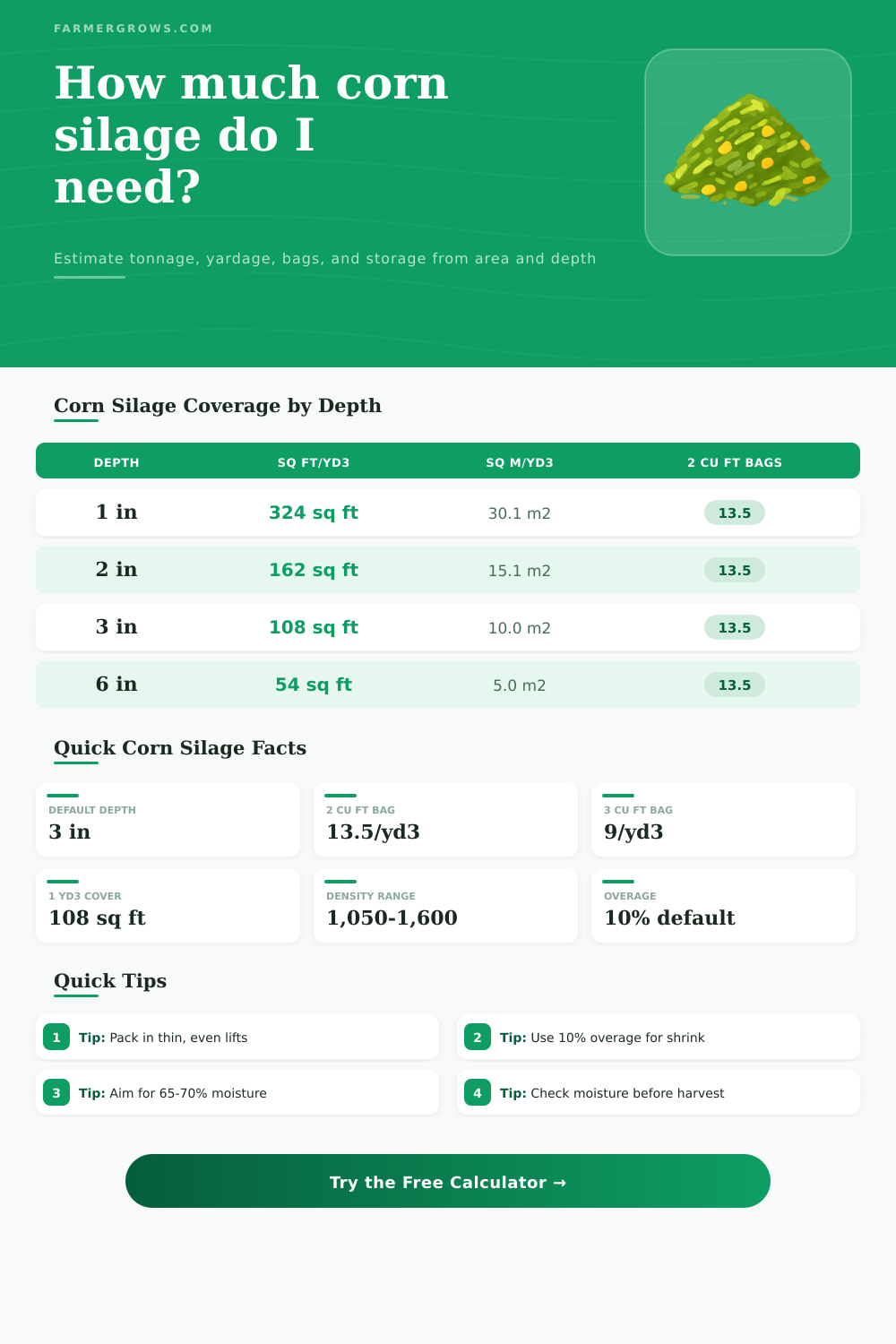
📏Coverage by Depth
| Depth | Sq Ft / yd³ | Sq M / yd³ | 2 Cu Ft Bags / yd³ |
|---|---|---|---|
| 1 in | 324 | 30.1 | 13.5 |
| 2 in | 162 | 15.1 | 13.5 |
| 3 in | 108 | 10.0 | 13.5 |
| 4 in | 81 | 7.5 | 13.5 |
| 6 in | 54 | 5.0 | 13.5 |
📦Bags vs Bulk Conversion
| Container | Volume | Bags / yd³ | Coverage @ 3 in |
|---|---|---|---|
| 2 cu ft bag | 0.074 yd³ | 13.5 | 8 sq ft |
| 3 cu ft bag | 0.111 yd³ | 9.0 | 12 sq ft |
| 0.5 yd³ tote | 0.500 yd³ | 2.0 | 54 sq ft |
| 1 yd³ bulk | 1.000 yd³ | 1.0 | 108 sq ft |
📋Common Project Sizes
| Project | Area | Cubic Yards @ 3 in | 2 Cu Ft Bags |
|---|---|---|---|
| 20 x 30 ft strip | 600 sq ft | 5.6 yd³ | 75 |
| 20 x 100 ft strip | 2,000 sq ft | 18.5 yd³ | 250 |
| 40 x 100 ft pad | 4,000 sq ft | 37.0 yd³ | 500 |
| 50 x 100 ft bunker | 5,000 sq ft | 46.3 yd³ | 625 |
| 0.25 acre block | 10,890 sq ft | 100.8 yd³ | 1,361 |
Corn silage is popular forage for ruminant animals because it has a lot of energy and is easy to digest. For maximum profit from production of corn silage, it is not enough to have only high yield but also good quality. Many factors affect the right management of silage, including the choice of corn varieties, plant population, time of harvest, height and length of cut and storage
Usually you estimate that one bushel of corn with 15 percent moisture matches 0.135 tons of corn silage with 65 percent moisture. Like this, a field with expectation of 170 bushels per acre gives around 23 tons of silage. In many regions corn silage gives 18 to 30 tons fresh per acre on a wet basis.
Corn Silage Yield, Quality and Cost
High-yield systems can reach 30 to 40 tons per acre. In 2023 the yield of corn for silage in harvested acre in United States was 20.1 tons.
The cost to produce a ton of corn silage ranges across farms and years. For instance, in 2019 Ohio corn enterprises reported an average amount of 18.8 tons per acre, although the amounts swung between 10 and 25 tons per acre. That shows a big spread.
Some rancher in New York occasionally harvested corn silage with 37 or 38 tons per acre, which is a huge amounet.
Grain amount of more than 200 bushels per acre gives only little extra per ton, which matches to around 28 tons per acre of 65 percent moisture corn silage. Some cases reached almost 11 bushels grain per ton of such silage. Commonly you plan with 7 to 8 bushels per ton, and even more than 8 for 250 bushel corn.
For stressed corn with amount of 100 bushels or less, expect one ton of silage for every five bushels grain.
Silage amounts grow with narrow rows at the same rate as grain. The increase can reach 10 percent. The main thought for changing harvest gear should be the costs.
Corn hybrids for silage usage should give high quality forage before frost. Unfortunately, only few tests inform about silage amounts and forage quality. Soil tests help fix fertilizer needs and fertilizing for maximum production.
Because of higher input prices and low sale prices, ranchers ask what expenses they can remove to lower production costs without strongly reducing yield.
Near fields help to estimate grain amount, or you leave check strips in the harvested field. Check strips answer for late or partial payment agreements. Final payment adjustments belong in a signed contract between buyer and seller.
Corn silage gives a bigger amount per hectare than grass or hay. Usually corn for silage produces almost three full cuts of grass, but requires less work than three grass harvests.
A fast way to price corn silage is to multiply the bushel price of corn grain by 8 to 10 for the ton price. A factor of 8 to 9 best answers for “field price”. In some regions all corn goes to animal feed, and dairy ranchers cultivate it chiefly for silage.