Hydraulic Pressure Calculator
Size pressure, force, stroke, and cycle time from one clean setup.
⚙ Pressure Inputs
📈 Pressure Results
📋 Pressure spec grid
📊 Reference tables
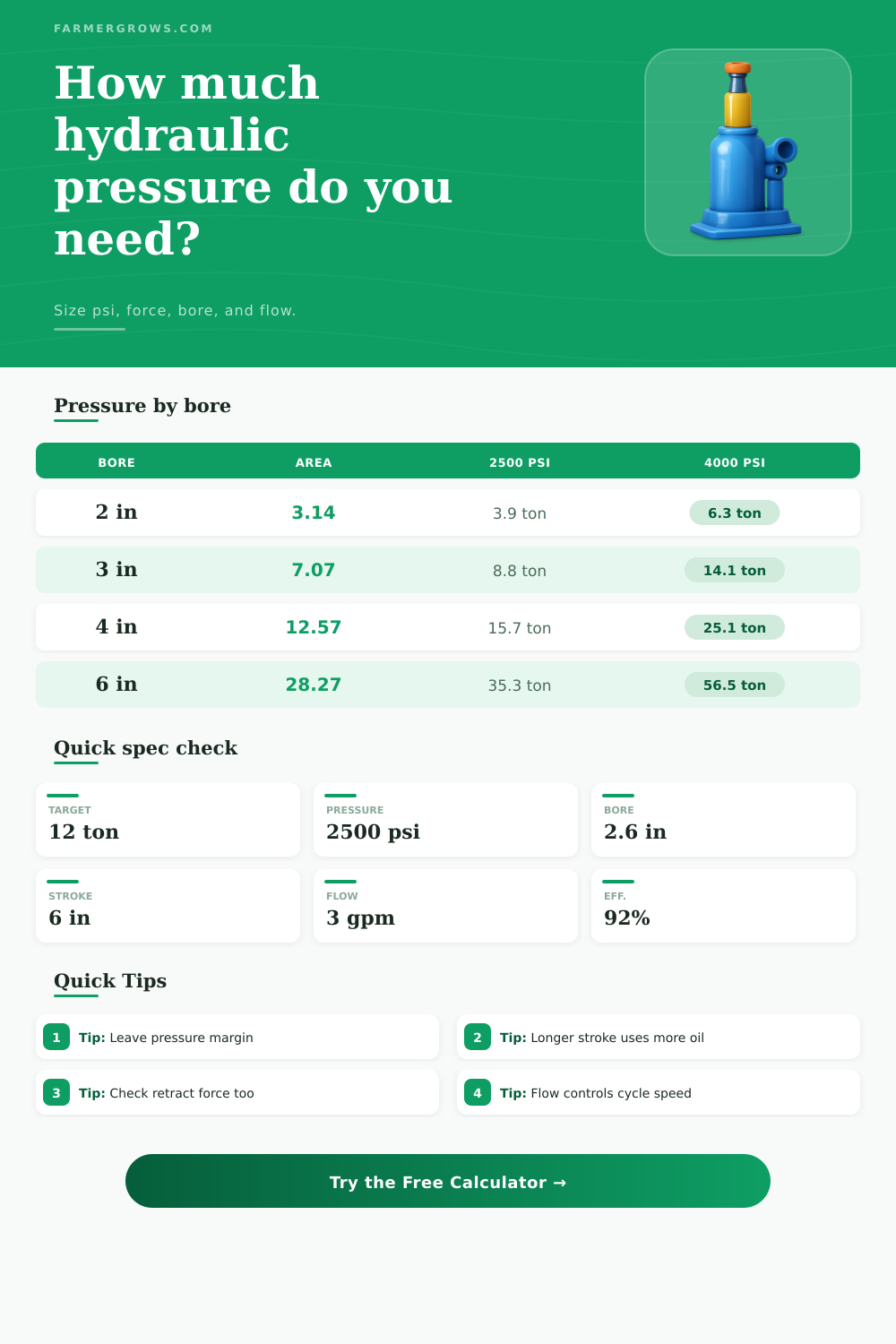
| Bore | Area | 3000 psi | 4000 psi |
|---|---|---|---|
| 2.0 in | 3.14 sq in | 4.7 ton | 6.3 ton |
| 3.0 in | 7.07 sq in | 10.6 ton | 14.1 ton |
| 4.0 in | 12.57 sq in | 18.9 ton | 25.1 ton |
| 6.0 in | 28.27 sq in | 42.4 ton | 56.5 ton |
| 8.0 in | 50.27 sq in | 75.4 ton | 100.5 ton |
| Bore | 4 in stroke | 8 in stroke | 12 in stroke |
|---|---|---|---|
| 2.0 in | 0.05 gal | 0.11 gal | 0.16 gal |
| 3.0 in | 0.12 gal | 0.24 gal | 0.37 gal |
| 4.0 in | 0.22 gal | 0.44 gal | 0.65 gal |
| 6.0 in | 0.49 gal | 0.98 gal | 1.47 gal |
| 8.0 in | 0.87 gal | 1.74 gal | 2.61 gal |
| PSI | Bar | 4 in bore | 8 in bore |
|---|---|---|---|
| 1500 | 103.4 | 9.4 ton | 37.7 ton |
| 2500 | 172.4 | 15.7 ton | 62.8 ton |
| 3000 | 206.8 | 18.9 ton | 75.4 ton |
| 4000 | 275.8 | 25.1 ton | 100.5 ton |
| Setup | Bore | Pressure | Stroke |
|---|---|---|---|
| 6 Ton Shop | 2.6 in | 2500 psi | 6 in |
| 20 Ton Frame | 4.1 in | 3000 psi | 8 in |
| 50 Ton Fabrication | 6.0 in | 4000 psi | 12 in |
| 100 Ton Dual-Ram | 6.0 x 2 | 4000 psi | 14 in |
💡 Pressure tips
Hydraulic pressure is force on a defined area that liquid applies in a closed space. Such pressure develops when you apply force to hydraulic fluid, and that pushes the fluid to move through the system. The fluid presses in all directions inside the vessel, tube, or whatever it contains.
Liquid cannot be compressed: it does not become smaller when you press it, unlike air. That is what makes hydraulic systems so efficient.
How Hydraulic Pressure Works
Hydraulic pressure forms because of resistance to flow. A prime mover, for instance an electric motor, is tied to a hydraulic pump. The motor turns the pump and creates flow.
The only job of the pump is to take the fluid from one place and put it to another. Pressure is the result of resistance against that flow. A hydraulic cylinder that is not connected to anything will extend and retract in low pressure because almost no resistance exists.
The higher the pressure is, the more force the system can deliver. But that costs: more losses appear in the system and stronger tubes, valves, and seals are needed. Such strengthened parts cost more money.
Hydraulic systems work by means of moving pressure through the whole arrangement. The pressure applied in one spot goes through the hydraulic fluid and works on the other parts of the system until a new balance is reached.
On a small farm such a type of machine can use a pump with fixed displacement. Modern systems commonly use arrangements of pressure-controlled flow that give pressure and flow only when needed. Instead of the system staying at the same pressure and flow all the time, both are controlled according to what the work actually requires.
That is a big change compared with how things worked before ten or fifteen years.
Hydraulic hose pressure simply relates to the amount of force that the hydraulic fluid applies inside the hose measured in pounds per square inch or in bars. You can classify hoses according to the pressure that they last under normal conditions: low, medium, and high pressure. Some hoses have an operating pressure of 6,000 PSI whih makes them good for off-road construction equipment and similar heavy work.
You actually have a problem that ocasionally appears on farms: connecting auxiliary hydraulics. Sometimes the pressure does not release from the system and because of that it is hard to tie the hoses. Also the sun heating the lines can increase the pressure.
Running fresh water over the cylinders and lines can help release enough pressure so that you can hook the equipment back up. While you run hoses it is commonly more easy to run them to the cylinder that sits closer to the source of hydraulic pressure instead of past an extra joint.