🔧 Hydraulic Hose Pressure Drop Calculator
Calculate PSI loss & flow velocity in hydraulic hose lines — Imperial & Metric
Most Common
Cold Climates
High Temp
Fire Resistant
Mobile Equip.
Heavy Duty
Very Thick
Thin Fluid
| Line Type | Max Velocity (ft/s) | Max Velocity (m/s) | Typical Use | Consequence if Exceeded |
|---|---|---|---|---|
| Pressure Line | 10–15 ft/s | 3.0–4.6 m/s | Pump to actuator | Erosion, heat, noise |
| Return Line | 7–10 ft/s | 2.1–3.0 m/s | Actuator to tank | Back-pressure buildup |
| Suction Line | 2–4 ft/s | 0.6–1.2 m/s | Tank to pump | Pump cavitation |
| Pilot / Control | 5–8 ft/s | 1.5–2.4 m/s | Valve actuation | Sluggish response |
| Case Drain | 2–5 ft/s | 0.6–1.5 m/s | Motor/pump drain | Bearing damage |
| Hose ID / Size | 5 GPM | 10 GPM | 20 GPM | 40 GPM | 80 GPM |
|---|---|---|---|---|---|
| -4 (1/4 in) | ~180 PSI | — | — | — | — |
| -6 (3/8 in) | ~35 PSI | ~110 PSI | — | — | — |
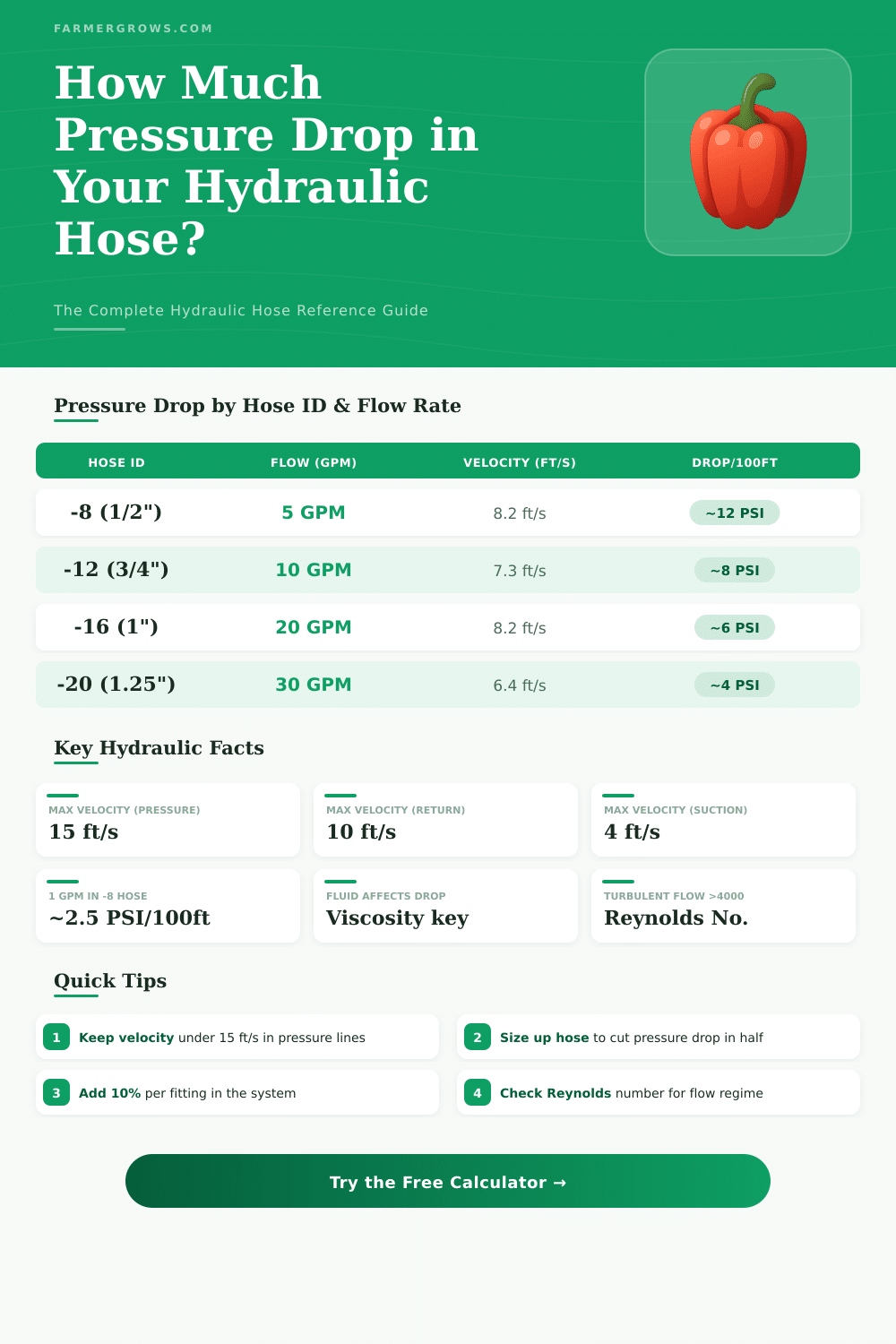
| -8 (1/2 in) | ~12 PSI | ~40 PSI | ~130 PSI | — | — |
| -10 (5/8 in) | ~5 PSI | ~16 PSI | ~55 PSI | — | — |
| -12 (3/4 in) | ~2.5 PSI | ~8 PSI | ~25 PSI | ~85 PSI | — |
| -16 (1 in) | — | ~3 PSI | ~9 PSI | ~30 PSI | ~100 PSI |
| -20 (1-1/4 in) | — | — | ~4 PSI | ~12 PSI | ~38 PSI |
| -24 (1-1/2 in) | — | — | ~2 PSI | ~6 PSI | ~18 PSI |
| -32 (2 in) | — | — | — | ~2 PSI | ~6 PSI |
| From | To | Multiply By | Example |
|---|---|---|---|
| GPM | L/min | 3.785 | 10 GPM = 37.85 L/min |
| L/min | GPM | 0.2642 | 50 L/min = 13.2 GPM |
| PSI | bar | 0.06895 | 100 PSI = 6.895 bar |
| bar | PSI | 14.504 | 10 bar = 145 PSI |
| inches | mm | 25.4 | 1 in = 25.4 mm |
| feet | meters | 0.3048 | 10 ft = 3.048 m |
| ft/s | m/s | 0.3048 | 10 ft/s = 3.05 m/s |
| cSt | cP (water=1) | x SG | 46 cSt x 0.87 = 40 cP |
| Application | Hose ID | Typical Flow | Hose Length | Est. Drop (ISO46) |
|---|---|---|---|---|
| Excavator Return | -16 (1 in) | 30 GPM | 20 ft | ~4 PSI |
| Forklift Pressure | -8 (1/2 in) | 8 GPM | 15 ft | ~18 PSI |
| Loader Suction | -20 (1-1/4 in) | 25 GPM | 3 ft | <1 PSI |
| Conveyor Drive | -12 (3/4 in) | 15 GPM | 40 ft | ~13 PSI |
| Ag Tractor Work Port | -8 (1/2 in) | 6 GPM | 12 ft | ~10 PSI |
| Crane Control | -6 (3/8 in) | 5 GPM | 30 ft | ~11 PSI |
| Hydraulic Press (HP) | -6 (3/8 in) | 3 GPM | 8 ft | ~5 PSI |
| Case Drain Line | -8 (1/2 in) | 2 GPM | 20 ft | ~4 PSI |
When you work with heavy machinery, tractors, skid steers, log splitters and alike devices, the hydraulic hose pressure is something that you must consider. The rated value for any hose measures in psi and is set by the producer based on the used materials, the build and the intended use. Choosing the right specification matters a lot when you choose a hose for your own needs
Hydraulic hoses belong to different pressure levels according to their structure. In the bottom end, hoses for low pressure last around 300 psi. Later come hoses for high pressure, that fit from 3,000 to 6,000 psi, those usually combine wire braid with spiral braid for bigger durability.
Choosing and Using Hydraulic Hoses Safely
That mix of wires ensures flexibility to the hose, while it stays quite solid. The pressure skill comes from the materials and the thickness of the wall, although some other factors also affect it.
In specifications as SAE 100R2AT you find yourself commonly, especially in construction and farming environments. It is built for high pressures and appears everywhere. SAE J517 works for medium hydraulic tasks and gives flexibility without losing life.
The main advantage of a hydraulic hose is that it takes strong pressure, moves the fluid effectively and stays flexible to go around the gear. That strengthened construction makes it work.
Here where it becomes interesting: the working pressure do not match the bursting pressure. Most hydraulic hoses have a 4:1 safety ratio; so if a hose is estimated for 5,000 psi working pressure, it will not burst before 20,000 psi. Which part of your system has the weakest rating?
That will be your bottleneck. Choose a hose with a rating a lot above your need to reduce the risk of failure and protect your people. Hose failure can cause severe wounds or even death.
For heavy uses as a log splitter, jacketed high-pressure hoses help to last the extreme conditions. Even so normal clamps and fixtures do not work for such pressure. Average pipe fittings fail soon under hydraulic loads.
You need high-pressure fixtures designed specially for fluid power, about that there is no debate.
Before you disconnect hoses on devices as skid steers, empty the pressure first. Both sides of the connector must be low pressure for safe linkup. Swing the joystick slowly in all directions for around ten seconds to discharge the pressure.
Do not use a hammer to connect hoses on a tractor. That is a red flag. Slackening a connection anywhere also releases pressure, but prepare for spray.
Naturally, no hose can create pressure. It only preserves it well. Using a hose with a big diameter, you minimize the pressure drop during the flow.