🌼 Chrysanthemum Watering Calculator
Find exactly how much water your mums need by growth stage, season & container type
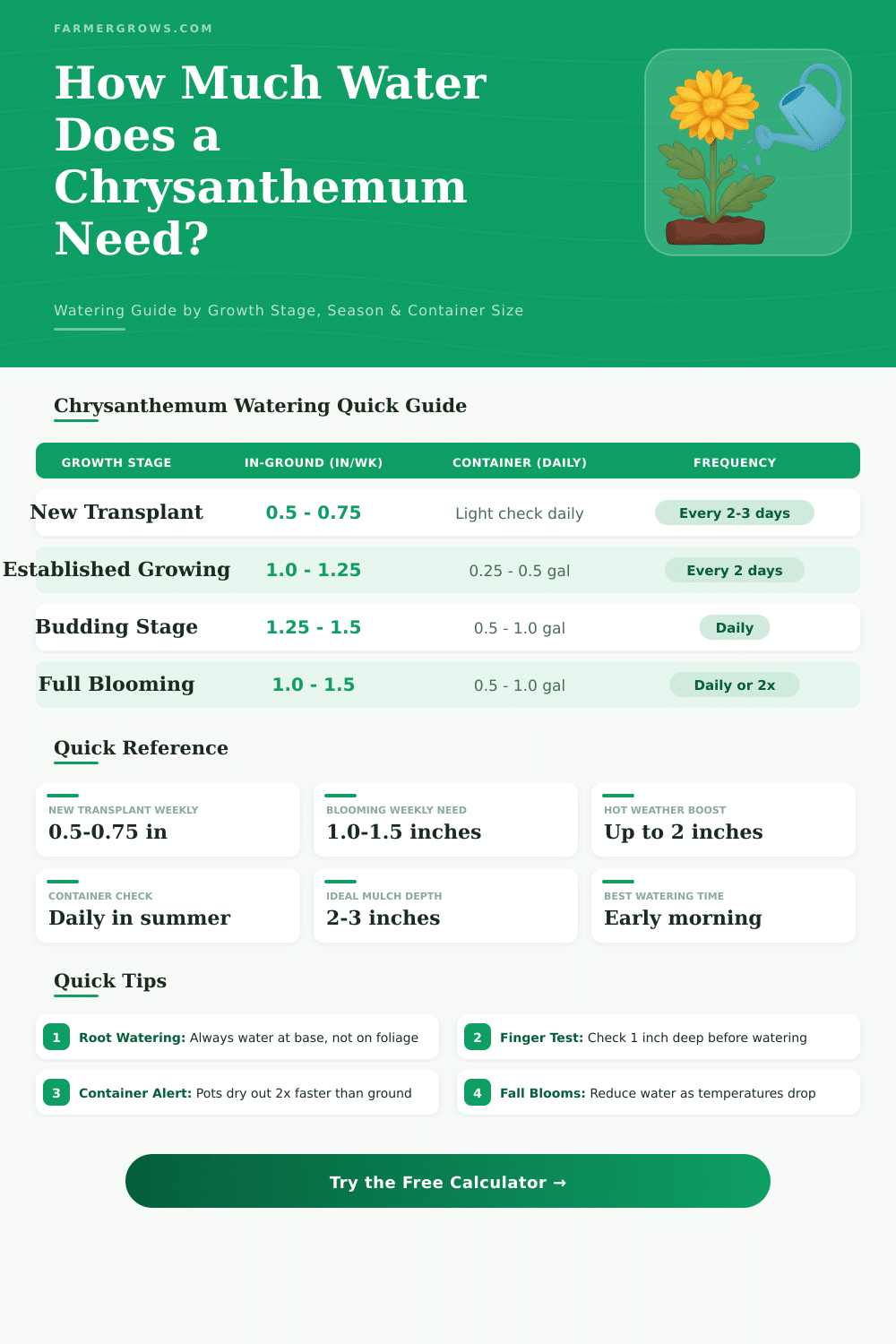
| Growth Stage | In-Ground (in/wk) | Container (gal/day) | Hanging Basket |
|---|---|---|---|
| New Transplant | 0.5 – 0.75 | 0.15 – 0.25 | Check daily, keep moist |
| Established Growing | 1.0 – 1.25 | 0.25 – 0.5 | 0.25 – 0.5 gal/day |
| Budding Stage | 1.25 – 1.5 | 0.5 – 0.75 | 0.5 – 0.75 gal/day |
| Full Blooming | 1.0 – 1.5 | 0.5 – 1.0 | Daily or twice daily |
| Container Size | Cool Days | Moderate (65-80°F) | Hot Days (80°F+) |
|---|---|---|---|
| 4–6 inch pot | Every 2 days | Daily – 0.1 gal | Twice daily |
| 1–2 gal pot | Every 2 days | Daily – 0.25 gal | Daily – 0.5 gal |
| 3–5 gal pot | Every 2–3 days | Daily – 0.5 gal | Daily – 0.75 gal |
| Hanging Basket | Every 1–2 days | Daily – 0.5 gal | Twice daily |
| Season | Typical Need | Frequency | Key Notes |
|---|---|---|---|
| Spring | 0.5 – 1.0 in/wk | Every 2–3 days | Establish roots; avoid overwatering new transplants |
| Summer | 1.0 – 1.5 in/wk | Daily or every 2 days | Water early morning; mulch to retain moisture |
| Fall | 1.0 – 1.25 in/wk | Every 2 days | Peak bloom season; consistent moisture is critical |
| Winter (Dormant) | 0 – 0.25 in/wk | Weekly or less | Barely moist; protect crowns from frost heave |
💡 Tip: Water at the Base, Not the Blooms
Always direct water to the soil around the base of chrysanthemum plants rather than overhead. Wet foliage and petals promote fungal diseases like botrytis and powdery mildew, which are common in mums. Use a soaker hose, drip line, or water wand aimed at the root zone. Watering early in the morning gives any accidental splash time to evaporate before nightfall. A 2 to 3 inch layer of mulch around plants significantly reduces how often you need to water by holding soil moisture between sessions.
💡 Tip: The Finger Test for Mums
Before watering, insert your finger 1 inch into the soil near the base of the plant. If the soil feels dry at that depth, it is time to water. If it still feels moist, wait another day and check again. Chrysanthemums prefer evenly moist soil but are vulnerable to root rot if kept too wet. Container mums dry out much faster than in-ground plants, especially in heat and wind, so check pots daily during summer and bloom season.
Chrysanthemum have many kinds and there are various ways to grow them. One of the main spots to keep those plants in good state is to ensure proper Water. The frequency of watering depends strongly on the weather.
In regions with enough rain Chrysanthemum almost do not require extra Water by hand.
How to Water and Care for Chrysanthemums
For potted Chrysanthemum, that does not receive direct sunshine and stand in 5-inch jar, around 0.5 cups of Water all 9 days works well. This counts for some species, also the Indian Chrysanthemum, Chrysanthemum ‘Bizarre’, Chrysanthemum ‘Katelli Yellow’ and Chrysanthemum ‘Samson’. All they have alike basic need about Water in such cases.
Potted Chrysanthemum dry more quickly than those planted in the soil. Even daily watering could be needed to avoid wilting, especially if big Chrysanthemum are in little jar. They tend to dry out soon.
A good method to check is to feel when the jar starts to feel heavy and the surface of teh ground seems moist. Everyday checking of the moisture is wise, because the needs range according to the climate.
There are practical ways to check the dryness of the ground. Take a sharp brush or wooden stick and push it in the jar until half of the weigh down. Wait five minutes, later pull it out.
If the tip is moist, skip watering. If it is dry, then Water. Another simple way is to Water when the ground feels dry down until the first joint of the finger.
In the time of flowering, Chrysanthemum require steady and enough watering to support all those flowers. Even so, the soil never should get fully dry. The Water must exit from the bottom of the jar.
Good drainage of Water and flow of air is very important. Keeping the plants dry on the surface truly helps to prevent problems like bugs and wet fungus, to which Chrysanthemum can be sensitive.
The ground itself also plays a big role. If the soil packs down and Water can not cross, the plant will not succeed. During the peak flowering, the soil must have enough food to support the plant.
Good mix is made up of local soil, compost, sand, coconut fiber, fungicide and food. Adding liquid food or long-lasting granular dressing also is useful. Chrysanthemum are such plants, that truly like food from the soil more than only Water itself.
Chrysanthemum are lasting plants, which means, that they live several years. They like much sunshine. New potting soil and biggerjar can truly help a difficult plant.