🌱 Grass Seed Per Acre Calculator
Calculate exactly how much grass seed you need for any lawn area — new seeding or overseeding
Kentucky Bluegrass
Tall Fescue
Perennial Rye
Bermuda Grass
Fine Fescue
Zoysia Grass
Buffalo Grass
Centipede Grass
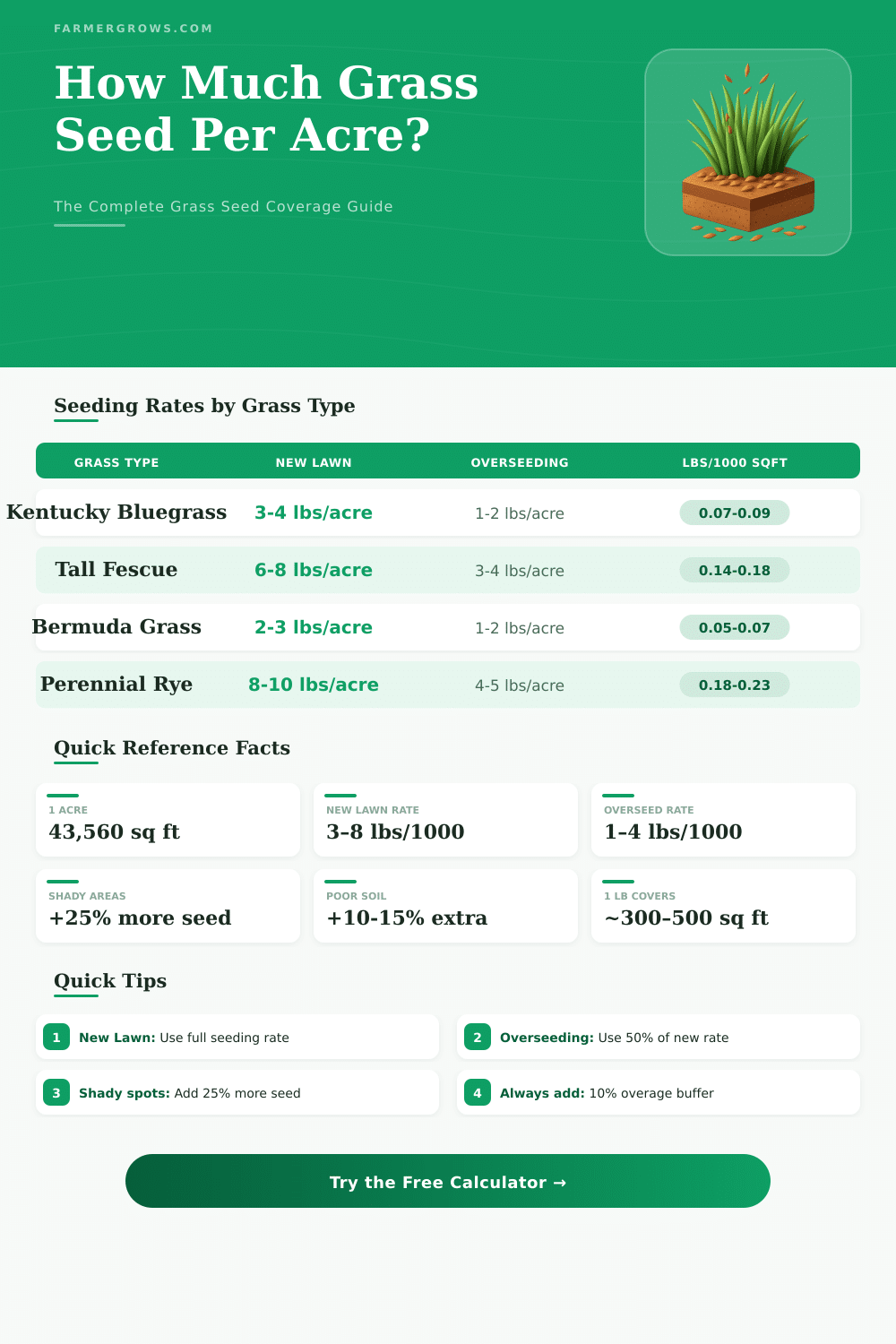
| Grass Type | New Lawn (lbs/acre) | Overseed (lbs/acre) | lbs/1,000 sq ft | kg/hectare |
|---|---|---|---|---|
| Kentucky Bluegrass | 130–175 | 65–87 | 3–4 | 145–196 |
| Tall Fescue | 261–348 | 130–174 | 6–8 | 293–390 |
| Perennial Ryegrass | 348–435 | 174–218 | 8–10 | 390–487 |
| Fine Fescue | 174–218 | 87–109 | 4–5 | 195–244 |
| Bermuda Grass | 87–130 | 43–65 | 2–3 | 97–145 |
| Zoysia Grass | 43–87 | 22–43 | 1–2 | 48–97 |
| Buffalo Grass | 43–87 | 22–43 | 1–2 | 48–97 |
| Centipede Grass | 11–22 | 5–11 | 0.25–0.5 | 12–25 |
| Area | Square Feet | Square Meters | Hectares |
|---|---|---|---|
| 1/4 Acre | 10,890 sq ft | 1,011.7 m² | 0.10 ha |
| 1/2 Acre | 21,780 sq ft | 2,023.4 m² | 0.20 ha |
| 3/4 Acre | 32,670 sq ft | 3,035.1 m² | 0.30 ha |
| 1 Acre | 43,560 sq ft | 4,046.9 m² | 0.40 ha |
| 2 Acres | 87,120 sq ft | 8,093.7 m² | 0.81 ha |
| 5 Acres | 217,800 sq ft | 20,234.3 m² | 2.02 ha |
| 10 Acres | 435,600 sq ft | 40,468.6 m² | 4.05 ha |
| Bag Size (lbs) | Covers (New Lawn) | Covers (Overseed) | Bags Per Acre (New) |
|---|---|---|---|
| 5 lbs | 500–1,000 sq ft | 1,000–2,000 sq ft | 43–87 bags |
| 10 lbs | 1,000–2,500 sq ft | 2,000–5,000 sq ft | 17–44 bags |
| 20 lbs | 2,000–5,000 sq ft | 4,000–10,000 sq ft | 9–22 bags |
| 25 lbs | 2,500–6,250 sq ft | 5,000–12,500 sq ft | 7–17 bags |
| 40 lbs | 4,000–10,000 sq ft | 8,000–20,000 sq ft | 4–11 bags |
| 50 lbs | 5,000–12,500 sq ft | 10,000–25,000 sq ft | 3–9 bags |
| Project Size | Area (sq ft) | Tall Fescue (lbs) | Kentucky Blue (lbs) |
|---|---|---|---|
| Small Backyard 30x40 | 1,200 sq ft | 8.4–11.2 | 3.6–4.8 |
| Medium Lawn 100x100 | 10,000 sq ft | 70–93 | 30–40 |
| 1/4 Acre Lot | 10,890 sq ft | 76–101 | 33–44 |
| 1/2 Acre Lot | 21,780 sq ft | 152–203 | 65–87 |
| 1 Acre | 43,560 sq ft | 304–406 | 131–174 |
| 2 Acres | 87,120 sq ft | 609–812 | 261–348 |
| 5 Acres | 217,800 sq ft | 1,523–2,030 | 653–870 |
Grass Seed is not simply a cause where one takes any package and expects miracles. You really need to adapt the seed to your own area (the local weather), the amount of light in various parts of the land and the goals that you have. Best choose certain kinds instead of following only famous brands, because even good companies offer many types and mixes fit for entirely different conditions.
In the north, grasses of cold season like Kentucky Bluegrass, fescue and perennial ryegrass grow without big troubles. Bluegrass especially deserved its fame as a basic option for forming thick, healthy lawns in parks around houses and sports fields of north areas. In the middle part of the land, some grasses handle both cold winters and warm summers without too much issues.
How to Choose and Plant Grass Seed
More south, grasses of warm season, Zoysia, Saint Augustine, Bermuda… Really like the warm temperatures and one plants them between the end of spring and start of summer.
When you care about dry, sunny places that heat up almost whole day, grasses resisting to lack of rain will be your helpers. For shady parts you need something other, grass that will not yellow under trees or beside houses. There is Dog Tuff, a sterile hybrid that one uses as plugs instead of seeds, because it does not spread naturally.
It, after settling, almost does not requrie water.
Autumn really is the best time for sowing. The foot traffic drops, the temperatures stay gentle and the roots have enough time to grow before the summer heats. Depending on the region wear you live, it is possible to sow even in November or December, because the grass uses the whole winter to grow strong with the help of each rain that helps the roots.
Professional lawns follow another plan, they sow at the end of August until whole September, spreading food and seeds to reach the best conditions.
Well preparing the ground really is worth the effort. Fork it until six inches deep, later mix in stuff that fixes the gaps in soil (compost, pH fixes) is a step for the future, before planting anything, because changing the ground after grass already grows makes everything much harder. Rolling flat over the forked surface levels everything well.
Then one uses a spreader for sowing according to the directions on the package. Sow half of the seeds in one direction, and the rest going across it, to help stop uneven covering.
Pre-emergent foods kill all seeds… Including Grass Seed, so they are strictly banned when trying to create a new lawn. Save them for already dense and stable lawns.
Grass Seed does not really need covering, but birds will eat the bare seed and without steady moisture everything fails entirely. For big dead areas, repeated sowing needs you to remove the dead grass down to bare ground before spreading new seeds. Overseeding works more for little thin places that simply need a bit of helpabove the existing.
At special stores of seeds and lawns you find pure material without fillers, tablets or unnecessary extras… That sprouts much better than what big home stores offer.