💧 Irrigation Water Calculator
Calculate exactly how much water your lawn, garden, or field needs for any irrigation scenario
(in/week)
(in/week)
(in/week)
(in/week)
(in/week)
(in/week)
(in/week)
(in/week)
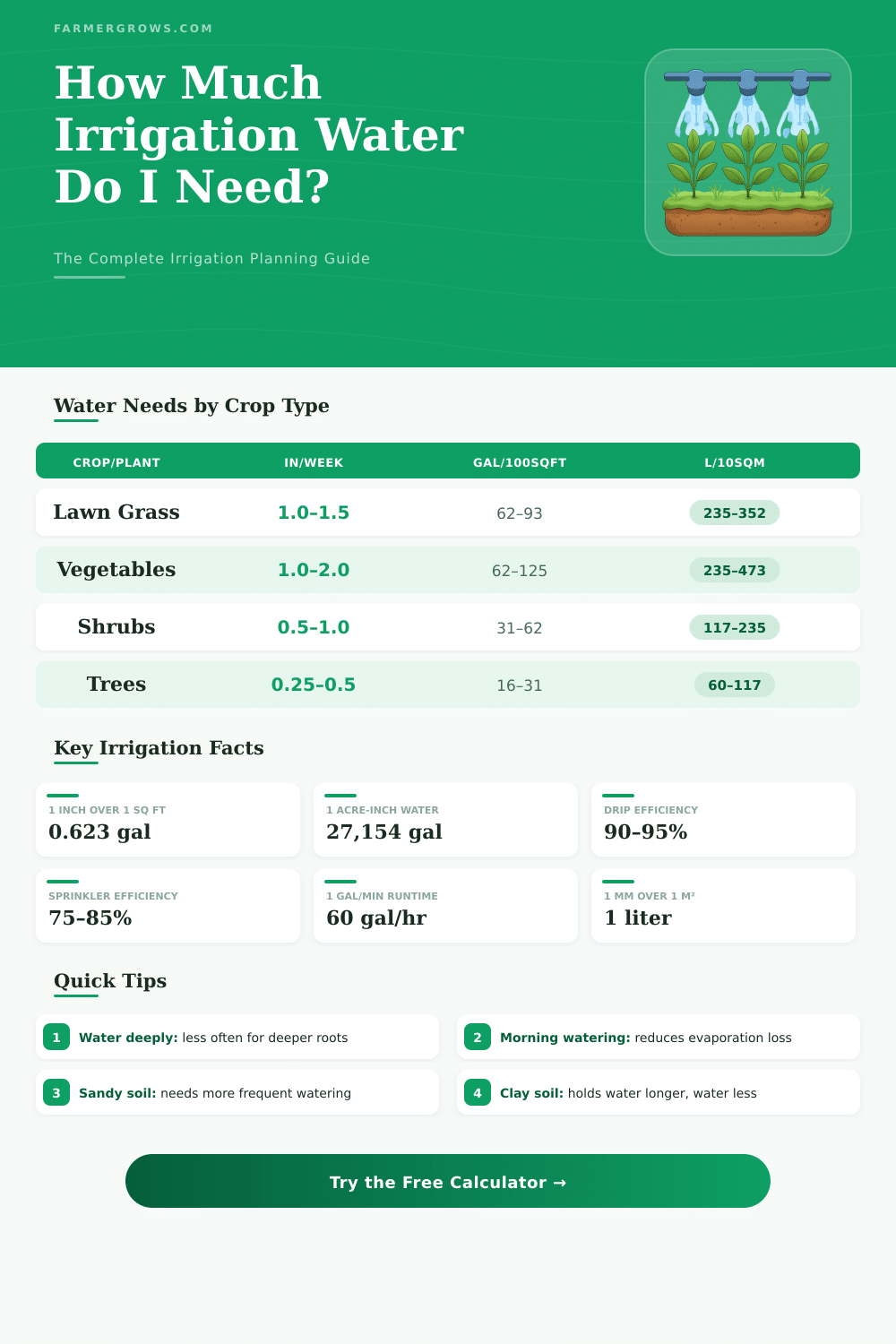
| Water Depth | Per 100 sq ft (gal) | Per 1,000 sq ft (gal) | Per 1 acre (gal) | Per 100 m² (L) |
|---|---|---|---|---|
| 0.25 in (6 mm) | 15.6 | 156 | 6,789 | 59 |
| 0.5 in (13 mm) | 31.2 | 312 | 13,578 | 118 |
| 0.75 in (19 mm) | 46.8 | 468 | 20,367 | 177 |
| 1.0 in (25 mm) | 62.3 | 623 | 27,154 | 236 |
| 1.5 in (38 mm) | 93.5 | 935 | 40,730 | 354 |
| 2.0 in (51 mm) | 124.7 | 1,247 | 54,308 | 472 |
| Irrigation System | Efficiency | Typical Flow Rate | Water Needed (gal) per 1,000 sq ft / 1 in depth | Notes |
|---|---|---|---|---|
| Sprinkler | 75% | 1–4 GPM/head | 830 | Factor in wind & overlap |
| Drip Irrigation | 90% | 0.5–2 GPH/emitter | 692 | Most efficient method |
| Flood / Furrow | 60% | Variable | 1,038 | High evaporation loss |
| Hand Watering | 65% | 2–5 GPM | 958 | Difficult to distribute evenly |
| Soaker Hose | 85% | 0.5–1 GPM/100ft | 733 | Good for rows & beds |
| Plant Type | Weekly Need (in) | 100 sq ft (gal/wk) | 1,000 sq ft (gal/wk) | 500 m² (L/wk) |
|---|---|---|---|---|
| Cool-Season Lawn | 1.0–1.5 | 62–94 | 623–935 | 2,358–3,537 |
| Warm-Season Lawn | 0.75–1.0 | 47–62 | 467–623 | 1,769–2,358 |
| Vegetables | 1.0–2.0 | 62–125 | 623–1,247 | 2,358–4,716 |
| Flowers & Annuals | 0.75–1.5 | 47–94 | 467–935 | 1,769–3,537 |
| Shrubs & Perennials | 0.5–1.0 | 31–62 | 312–623 | 1,179–2,358 |
| Established Trees | 0.25–0.5 | 16–31 | 156–312 | 590–1,179 |
| Field Crops | 1.0–2.5 | 62–156 | 623–1,559 | 2,358–5,896 |
| Herbs | 0.5–1.0 | 31–62 | 312–623 | 1,179–2,358 |
| Project | Area (sq ft) | Gallons Needed | Liters Needed | Weekly (3x) gal |
|---|---|---|---|---|
| Small Lawn 20x15 | 300 | 249 | 942 | 747 |
| Medium Lawn 50x30 | 1,500 | 1,246 | 4,717 | 3,738 |
| Veggie Garden 10x8 | 80 | 66 | 251 | 199 |
| Sports Field 100x80 | 8,000 | 6,648 | 25,160 | 19,944 |
| Full Yard 200x150 | 30,000 | 24,930 | 94,349 | 74,790 |
| Flower Bed 30x10 | 300 | 249 | 942 | 747 |
Irrigation water ranks between the main uses of water through the whole world. It backs the growth of fruits, vegetables and cereals to feed the world. That happened during thousands of years.
The basic irrigation is made up of the use of set amounts of water to help the growth of crops, landscapes, plants and meadows. It forms the base of farming for more than 5 000 years and spread through many cultures everywhere.
Ways to Water Crops and Save Water
In its essence irrigation intends to deliver water to the crops at the right moment. Water does not lack for the growth of vegetables, flowers, fruits and seeds. Usually the goal is to keep rich harvest using the smallest possible amount.
Some crops, for example rice, require heavy watering, so one floods the fields so that the water goes inward.
Various methods of irrigation exist. Micro irrigation spreads little amounts of water straight to the plants. Systems with sprinklers scatter water by means of nozzles.
Flood or channel systems fill the ground or lead water along grooves. The surface irrigation uses the most water, because only a tiny part truly arrives to the roots; the rest simply flows through the furrows.
Drip irrigation is one of the favorite solutions. It moves water together with nutrients directly to the root area of every plant, in precise doses and at the useful time. Like this every plant receives exactly what it requires.
Slowly common devices, as drip irrigation, drip tubes and drip tapes, use plastic tube on the surface or a bit underground. Little holes in the tubes give water directly to separate plants. Such systems use fewer water and reduce the appearance of weeds, and they ease precise local watering.
Farming reports about 70 percent of the world’s water use. The waste of water forms a real challenge and expense for the farmers, especially in regions with little water. When you combine it with ground and plant-based sensors, you can get very exact sight about the Irrigation water demand in real time.
Center-pivot irrigation helps some farmers too assemble their crop fields.
Irrigation setup stores all the tubes, links, sprinklers, drip tubes, valves, control tools and joined parts, that one lays to provide water. With smart controls it is possible to change the water amount based on the rainfall and the heat. One percent growth of the organic soil can allow it to hold an extra 20 000 gallons of water each acre, that the crops use when they most require it.
Farm engineers use satellite tracking to create location-specific Irrigation water nets, thatspares water by means of better results.